Learn the clues
Build a buck first. Drag the slider and watch what changes. Then read the five lessons.
- Strong clueLegs look too long for the body
- Strong clueSkinny neck that joins high on the chest
- Weak clueTight belly, thin waist
Legs
A yearling looks like he is standing on stilts. His legs never get shorter, but his body keeps getting deeper for years. On a mature buck the same legs look short.
Biologists call a yearling "a doe with antlers" because he is so slim.
Neck
Follow the bottom of the neck down to where it meets the body. On a young buck it joins high, about the middle of the chest, and you can see where the neck stops and the shoulder starts.
On a mature buck the neck is thick and runs straight into the brisket, the front of the chest. Neck and chest look like one piece. On a Texas ranch that kept records on bucks of known age, neck size was the body clue that tracked age best.
Chest, belly and back
At 3.5 a buck looks like a racehorse: deep chest, tight belly, flat back. By 4.5 his waist is as deep as his chest.
After about 5.5 the belly starts to sag and the back starts to dip. A very old buck gets bony and can look young again from far away.
Antlers lie
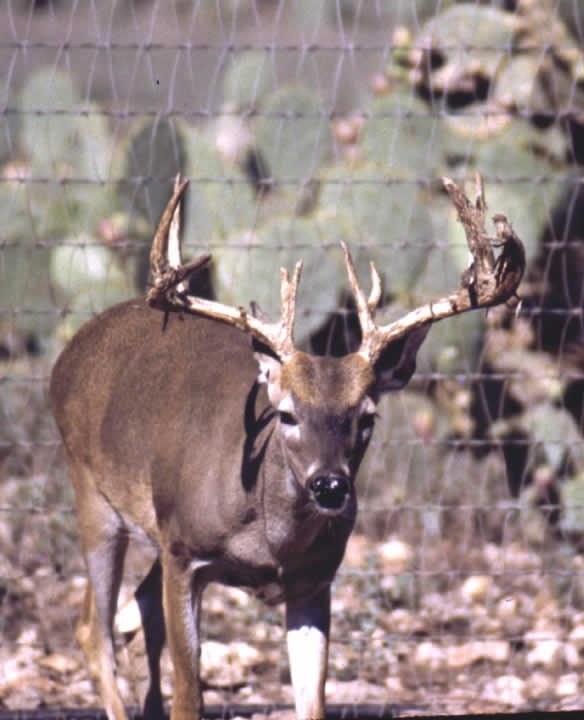
Buck 01-12 from the Kerr Wildlife Management Area research herd. 12 points, 20 inch spread, and one and a half years old.
Antler size depends on food, family and luck as much as age. Most bucks grow their biggest antlers between 5 and 7 years old, but two bucks the same age can look completely different. Check the body first. Use antlers only to break a tie.
Time of year
These two drawings are the same buck. In the fall breeding season, called the rut, a mature buck's neck swells up. In summer it does not.
During the rut a buck can lose up to a quarter of his weight, so he looks thinner in January. Always ask what month the picture was taken.
Why age bucks at all?
Ranchers and biologists want a healthy deer herd with bucks of every age. If hunters can tell a young buck from an old one, they can let the young ones walk and grow up.
A buck is not full grown until he is somewhere between 4.5 and 6.5 years old. Only a small share of wild bucks live that long.
How sure can you be?
Not very, for the exact year. Even experts miss it most of the time. Sorting a buck into young, middle or mature is what works, and that is what the game scores.
Play round 1